Unearthing the New AfterLife Array
KDZU Recovers a Subterranean RF Network and the Caretakers Who Keep It Alive.
KDZU’s Wave Farm 2026 Transmission Residency Submission
KDZU is an autofictional interventionist transmission platform that operates at the intersection of speculative media, networked infrastructures, and tactical mythmaking. It produces site-responsive works that use radio, networking technologies, and narrative fabrication to create participatory environments where fiction and infrastructure blur. Through installations, performances, and embedded artifacts, KDZU explores decentralized communication, collective authorship, and the politics of signal, memory, and presence.
KDZU’s Goldfield, Nevada, outpost recently received an unsigned letter* in the mail, postmarked but otherwise unadorned, containing a hand-drawn map, technical sketches, and a claim that the Memphis, Tennessee-based OMSA** (Orange Mound Space Agency) robotics and interventionist transmission collective may have persisted beyond the 1994 “Great Raid” on their Memphis Pyramid squat.
According to this letter, while many OMSA members scattered westward, the OMSA (Our Methods Seem Abstract) RF research group traveled north and east, establishing a provisional site in the northern Catskills near present-day Acra, New York. The letter describes this region as strategically chosen for its seclusion, low population density, and hilly terrain. These conditions, the residents of Wave Farm already understand, are favorable for experimental long-range transmissions, signal occlusion, and off-grid communications.
KDZU approaches the claims in this letter as an activation point for its tactical mythmaking activities: a prompt to investigate, reconstruct, and extend a speculative lineage of OMSA’s (One More Sexy Anarchist) transmission experiments, which took place over thirty years ago at the Wave Farm site.
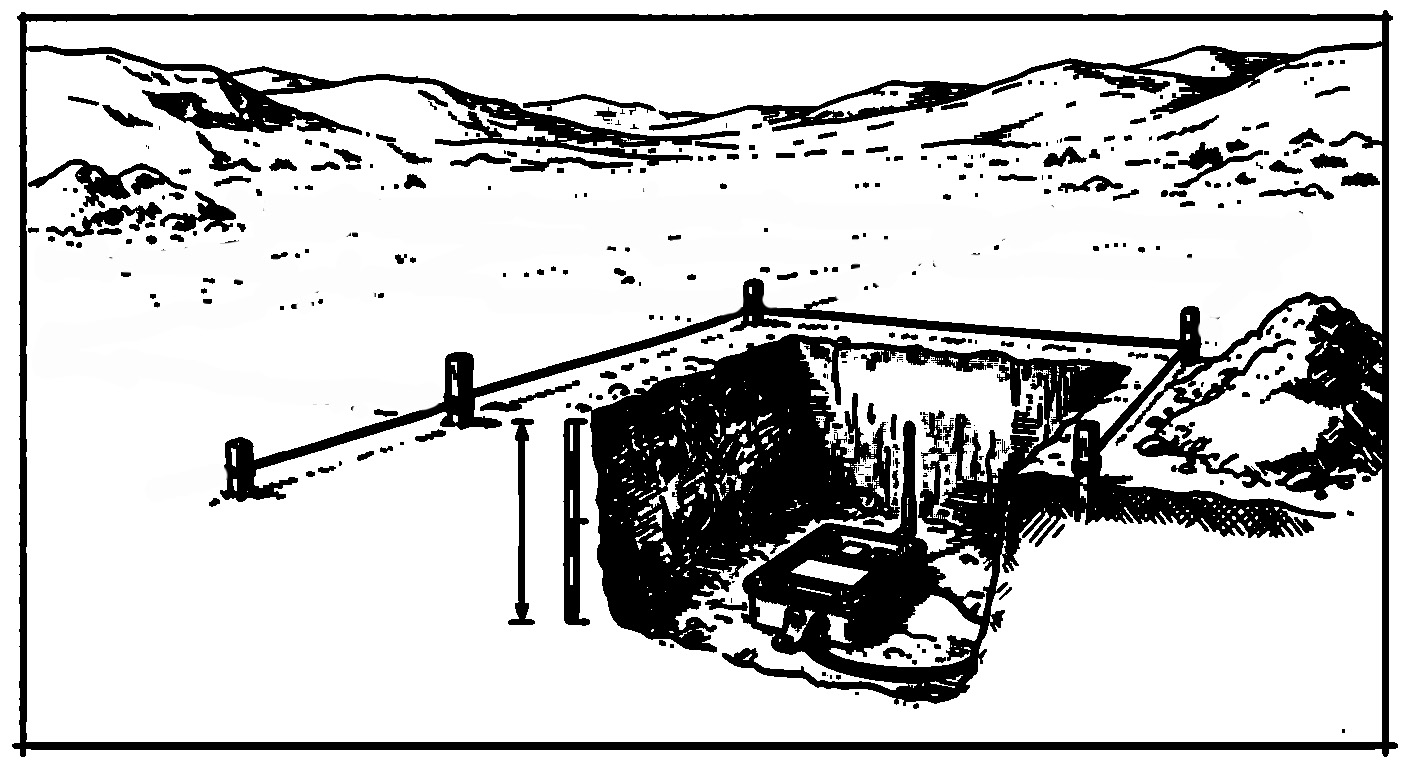
What Will KDZU Discover? KDZU proposes developing the New AfterLife Array, a Meshtastic-based (LoRa and LoRaWAN), long-range, off-grid communication network that was fictitiously developed and buried by OMSA (Origin Myth Site Acra). This mesh-enabled multi-node instrument will be fictitiously unearthed, activated, and presented across the Wave Farm site.
The installation will present four nodes from OMSA’s (Our Memphian Signaling Architecture) network, G, F, N, and H, each corresponding to a letter in the word GOLDFINCH, a bird native to the Acra, NY region known for its waveform-like flight pattern. This partial recovery suggests that five additional nodes may exist elsewhere in Upstate New York, possibly awaiting discovery or may be permanently lost.
Each of these four nodes consists of five components
| Component | Description |
|---|---|
| Meshtastic radio | Handles LoRa mesh communication between nodes. |
| Interpreting Unit | A Raspberry Pi Zero 2 W, connected to the Meshtastic node over USB/serial, running KDZU-authored code that interprets FRMPayload (Frame Payload) data into MIDI. |
| Sound Interpolator | An Akai MPC Sample workstation connected via USB MIDI that translates the signals into sound. |
| Sound Amplifier | A small self-powered speaker |
| Power System | A small solar panel and charging system for the electronics. |
At Wave Farm, the New AfterLife Array functions as both a fictional field test of a long-dormant system and a contemporary experiment in decentralized transmission. It privileges slowness, intentionality, and communication as an ongoing, collectively activated process.
Using LoRa mesh devices distributed across the landscape, the project treats transmission as durational and accumulative: signals move slowly, degrade, repeat, and require multiple encounters to be perceived. As messages propagate through the network, they form an evolving archive of interruptions, delays, and relays. Visitors will also encounter fragments of OMSA’s (Ongoing Mutual Signal Attunements) surreptitious caregiving of the system, such as maintenance logs, instructions for future care, and transmission records. Some bits will be translated into sound and spoken text to be activated by the Array. The four nodes operate as a distributed, mesh-enabled sonic instrument that performs both its signals and its artifacts.
It is OMSA’s (Our Mesh Subverts ARPANET) contemporary anarchist response to J.C.R. Licklider’s once imagined “Intergalactic Computer Network,” a 1960’s vision of globally interconnected computers enabling shared access to information, an early articulation of the internet as an “electronic commons.” Reinterpreted at Wave Farm, this project takes up that vision through a recently unearthed low-power, collectively maintained system contingent on human presence, proximity to others, and human+transmitter+receiver collaboration.
This work also draws from the legacy of upstate New York’s many historical intentional community experiments I encountered while living in Troy, New York: utopias that collapsed, dispersed, or dissolved, yet left behind important traces, structures, and ideologies that continue to resonate in ways that can be more potent than the utopianists' original intentions and methods. The New AfterLife Array treats failures as symbolically generative transmissions that sometimes persist and develop potency beyond their original intentions.
FRMPayload (Frame Payload) Communications Messaging Signals
| Signal |
|---|
| PLAY BELL |
| SCENE GRAVE |
| NODE 4 WAKE |
| ALL HUSH |
| ECHO 3 |
| TEMPO 62 |
| MUTE NORTH |
| PANIC |
| RELAY DUST |
| CRYPT OPEN |
Then each node has its own local mapping table, for example:
NODE “G”
| Signal | Mapping |
|---|---|
| PLAY BELL | MIDI Note 36 |
| SCENE GRAVE | Program Change 12 |
| ALL HUSH | CC 7 to volume 20 |
| TEMPO 62 | internal sequencer rate change |
| ECHO 3 | trigger sample 3 with long decay |
Additional distributed instrument components
Notes
* The unsigned letter referenced in this proposal draws inspiration from Letters to the Mount Wilson Observatory (1915–1935), a collection of 33 letters sent by members of the public to astronomers in California, often expressing highly idiosyncratic understandings of the universe. The letters were later compiled into the book No One May Ever Have the Same Knowledge Again and are exhibited at the Museum of Jurassic Technology in Los Angeles.
** Members of OMSA (Ornery, Methodical, Sassy, and Angsty) developed their name as a deliberately unstable acronym, re-proclaimed with new words on each instantiation as a form of tactical opacity. This continual mutation of meaning functioned as a defensive gesture, preventing the group’s intentions, structure, or ideology from being fixed or fully knowable. This preserved the group’s capacity to operate as a distributed, evasive entity, untethered from specific affiliations, art genres, or creative frameworks. KDZU respectfully maintains this naming system, even though it seems the group has been inactive since 1994.